Yonghe & Guozijian worship, learning, two institutions
Red walls and axial courtyards make the neighbors look visually related, but their purposes differ. Enter Yonghe as an active Tibetan Buddhist temple; cross to the Confucian Temple and Imperial College as a museum of ritual and state learning.
Four thresholds change your behavior
Ticket, gate, hall and worshipper each create a boundary. Read them before raising the camera or joining a queue.
Confirm the official channel
Yonghe and the museum complex use different systems. Verify current hours, closed days and passport handling separately.
Let signs lead
Photography, incense, circulation and restricted zones can differ by space. Obey the rule in front of you.
Yield to worship
Do not step between a worshipper and a shrine, block prostration space or convert prayer into a close-up scene.
Keep temple and academy distinct
The strongest visit comes from comparison without merger: how bodies move through sacred halls, then how architecture staged education, examination culture and state ritual.
Living Buddhist practice
Prioritize active use, icon placement, incense and the sequence of halls; historical palace origins do not make it only a museum.
Institution of learning
Read gates, steles, lecture space and the central hall as a system for education and governance.
Ritual and commemoration
Notice how worship of Confucius and scholarly memory sit beside, but are not identical to, the academy.
Use the transition
Guozijian Street is the decompression space. Walk rather than rushing straight from one ticket check to the next.
A compact worship code
Visitors do not need to imitate ritual they do not understand. Respect is clearer: dress and move conservatively, lower the voice, follow queues and staff, and never force a photograph.
What respectful attention looks like
- Observe first: pause after each threshold to understand movement.
- Keep distance: give worshippers room around incense, prayer and prostration.
- Protect interiors: obey photography and bag restrictions in every hall.
- Ask carefully: consent is required for close portraits, even in a public courtyard.
Begin with the place that needs quiet attention
Yonghe Temple
Arrive with the correct booking or ticket route, then move through the halls without racing worshippers to the next doorway.
Guozijian Street pause
Stop for orientation and a drink. The transition helps the museum complex become a new chapter rather than more red walls.
Confucian Temple and college
Use labels, steles and courtyard axes to build the history of education instead of treating the grounds as a backdrop.
Choose one neighborhood extension
Add a meal or short public-lane walk; save Shichahai or 798 for a separate chapter unless energy remains high.
Yonghe and Guozijian FAQ
Which should I visit first?
Yonghe first often works because active worship benefits from fresher attention and an earlier window. Move to the museum complex after a short reset.
Can I use the same ticket for both?
Do not assume so. They are separate institutions; check each current official ticket and opening page.
How should I dress?
Use conservative, comfortable clothing suitable for an active religious site, and follow any more specific current instruction at the entrance.
Is this a full-day route?
A substantial half day is enough for both institutions at a thoughtful pace. Add only one light neighborhood extension.
Old civic time, contemporary art or full city?
Official sources and photo credit
Reviewed 27 August 2026. Religious-site booking, museum hours, closed days, photography and access rules change. Image was resized and converted to WebP; visible framing may crop the display.
- Beijing Municipal Government - Yonghe Temple and Confucian Temple/Imperial College visitor information.
- Beijing Municipal Government - Yonghe Temple current visitor and reservation reference.
- Beijing Municipal Bureau of Culture and Tourism - Guozijian guide.
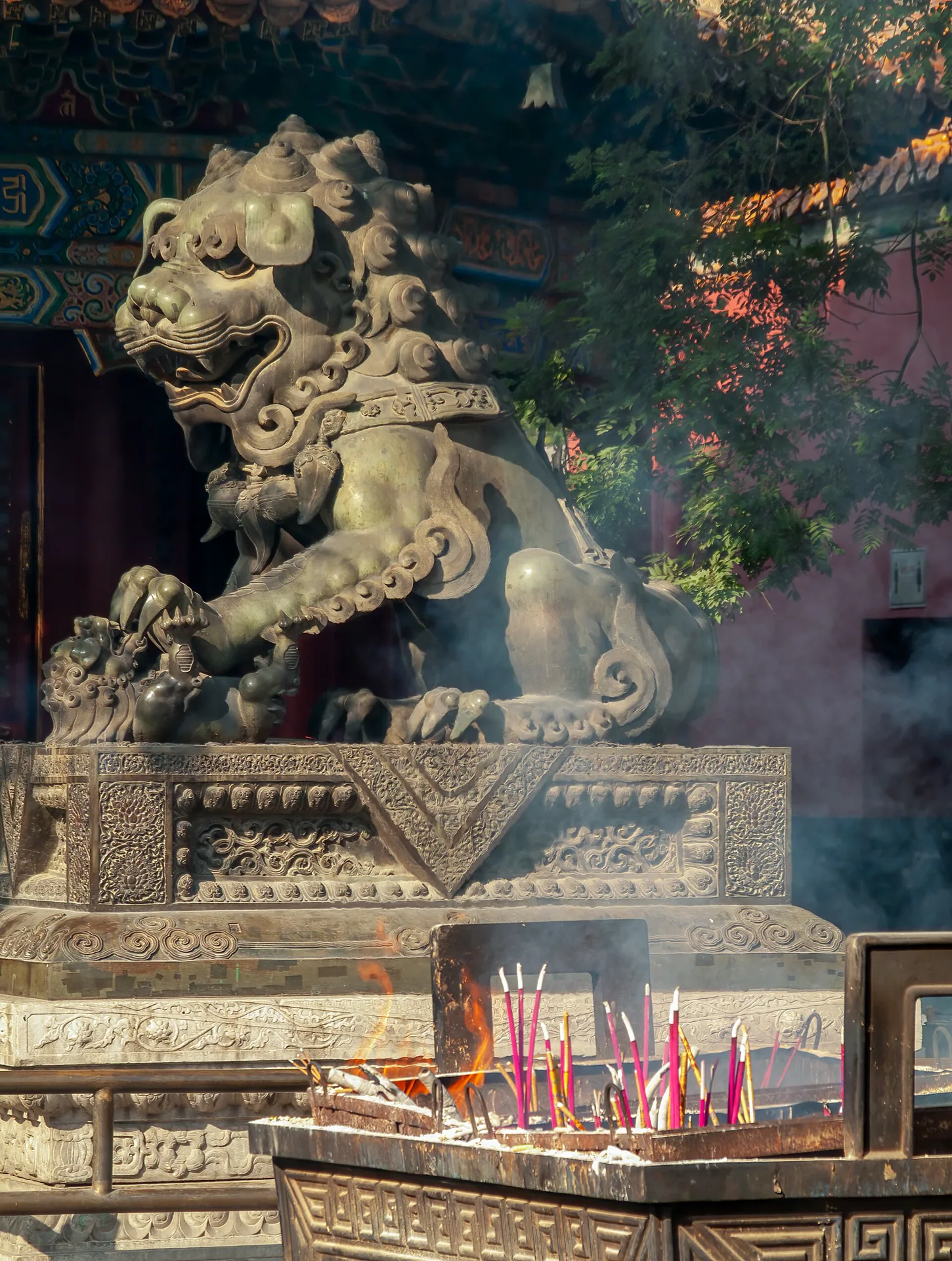
- Yonghe Temple guardian - Ermell, CC BY-SA 4.0; resized and converted to WebP, display crop.