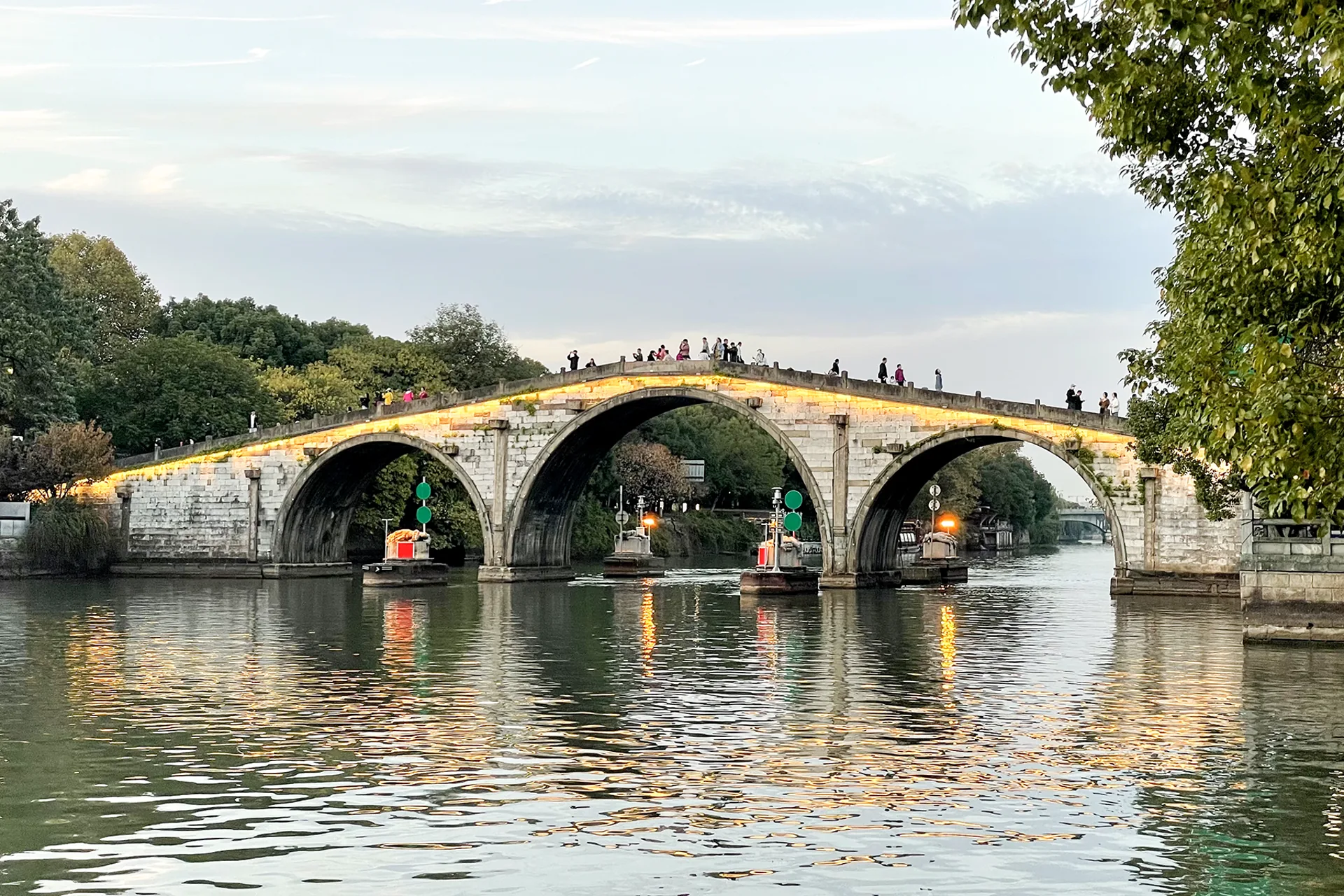
Grand Canal & Gongchen Bridge read Hangzhou beyond the lake
At Gongchen Bridge, the Grand Canal is not scenery pasted onto a shopping street. It is infrastructure, migration, craft, industry and neighborhood memory. Plan one clear canal argument instead of collecting disconnected waterfront stops.
Follow what the waterway moved
The strongest visit progresses from scale to evidence: crossing, cargo, craft, homes and the present-day waterfront.
Gongchen Bridge
Cross once, then step back to see the full stone profile. The bridge marks a threshold between the old canal approach and modern Hangzhou.
The water corridor
Look for embankments, moorings and the proportions of a route built to move goods and people, not merely frame photographs.
One museum
Choose a museum by subject—canal history, craft or industry—and verify its current location and hours. A focused visit beats racing through a cluster.
Bridge-side lanes
Walk slowly through surviving streets without treating residential thresholds as displays. Cafés and shops are only one layer of the neighborhood.
Evening water
Return to the bank as lights appear, then leave by a transport point you identified before dusk.
Use the bridge as a hinge, not a finish line
Arrive on the near bank
Save the exact bridge name and your chosen museum in Chinese. Metro, bus, taxi and water-bus combinations can change; verify the final approach on the day.
Cross with context
Read the UNESCO canal overview first, then observe the span, approaches and continuing navigation. Avoid blocking the narrow pedestrian flow for photographs.
Choose one deep stop
Give one museum or interpreted building enough time to connect trade with daily life. Check reservation and last-entry rules before leaving your hotel.
Close along the bank
Use the softer evening light for a short waterside loop. If taking a boat, confirm where it ends before your return route becomes an assumption.
Pick the version that answers your question
History-led
Bridge, canal museum and a compact old-lane loop. Best for first-time visitors who want the waterway's national scale explained.
Design-and-craft led
Choose one specialist museum or workshop, then compare reused industrial buildings with older domestic lanes. Confirm photography rules.
Water-led
Pair the bridge with a verified public boat or water-bus segment. Treat the timetable and destination as transport facts, not a decorative extra.
Small checks prevent a fragmented day
Do not search by “canal” alone
The heritage corridor is long. Save Gongchen Bridge, the specific museum and the intended exit separately; similarly named stops can be far apart.
Respect the working edge
Keep clear of cyclists, delivery traffic, boat operations and residential doorways. Railings and wet steps are not invitations to climb closer to the water.
Separate cruise from commute
Sightseeing boats and public water transport may use different piers, fares and schedules. Verify the operator's current information rather than relying on an old itinerary.
Grand Canal FAQ
Is Gongchen Bridge close to West Lake?
They belong to different parts of Hangzhou and should not be treated as one walk. Allow for a cross-city transfer and plan the canal as its own half-day.
Which canal museum should I visit?
Choose by your strongest interest and check the institution's official listing for current hours, entry and temporary closures. The cluster can change, and not every venue needs to be visited.
Is the area best by day or at night?
Daylight gives better architectural and museum context; early evening adds atmosphere. Arrive early enough to see both rather than appearing after interpretation venues close.
Can this pair with Hefang Street?
Yes, but it creates two separate historical districts and a transfer. Pair them only if you have a full day and a clear reason; otherwise each works better with nearby stops.
Official sources and photo credit
Planning facts and the image license were reviewed on 28 August 2026. Museum hours, boat routes, fares and transport change; verify current operators. The image was resized, center-cropped and converted to a 1920 × 1280 WebP file; no other material changes were made.
- UNESCO World Heritage Centre — The Grand Canal.
- Hangzhou Municipal Government — Gongchen Bridge and canal heritage.
- Gongchen Bridge — Windmemories, CC BY-SA 4.0.