South river the capital as world port
Ayutthaya's brick core can hide the movement that sustained it. Japanese, Portuguese, Dutch and other communities occupied connected river-side worlds. The surviving traces are uneven, so this chapter uses interpretation and source quality as its route.
Four columns rebuild a port city
Read people, cargo, water and evidence together. No single marker can carry the entire international story.
Communities, not flags
Merchants, diplomats, religious figures, soldiers, families and intermediaries had different roles. Avoid reducing a settlement to one famous man.
The river was infrastructure
Boats linked quarters, court and overseas networks. Today's road route should not erase the historic logic of the banks.
Read what survives
Interpretive centers, archaeology, worship sites and later memorials carry different kinds of evidence. Label the difference.
Use Japanese Village to ask wider questions
The official Japanese Village presents the Japanese community's relationship with Ayutthaya. Read its current exhibitions and river setting, then resist treating one national narrative as the complete foreign-settlement history.
Check current operation
Use the official site for current opening, programs and contact. Do not travel to the outer bank on an inherited schedule.
Separate person and network
Individual biographies can orient the story, but trade depended on institutions, local partners and a much larger community.
Stand by the river
Use the bank to understand why a quarter existed here and how movement connected it to the capital.
Compare evidence
Look for official interpretation of other communities rather than assuming identical organization or survival.
Distinguish archaeology, memorial and reconstruction
Some locations preserve excavated fabric; others maintain worship, interpretation or commemorative landscapes. A useful visit names which layer it is seeing and avoids presenting a modern display as untouched seventeenth-century evidence.
Three questions at every stop
- What is original? Identify excavated or surviving fabric.
- What is interpreted? Read the institution and evidence behind the display.
- What is remembered? Notice how later communities choose to commemorate the past.
Use UNESCO, Fine Arts Department and the operating institution as starting points; compare claims rather than copying a single unsourced plaque.
Follow one bank, not every nationality
Verify two sites
Check current opening and map the exact road sequence before hiring transport or riding south.
Japanese Village
Use the exhibition and river edge as a documented entry into Ayutthaya's international communities.
One second trace
Choose an official or clearly interpreted European or religious site whose current access is confirmed.
Finish on the same bank
Continue toward Phanan Choeng or return to the island without an unnecessary sequence of bridges.
South-river history FAQ
Why were the settlements along the river?
The waterways connected the capital to regional and overseas commerce. River access was transport infrastructure, not decorative scenery.
Is Japanese Village an original preserved town?
It is an interpreted historical site. Use the operator's material to distinguish archaeology, reconstruction, exhibition and later commemoration.
Can I see every foreign settlement in one day?
It is possible to pass several markers, but a stronger half day reads one or two sites carefully. Distances, heat and uneven interpretation make checklist travel low value.
How should I get around?
Use an agreed vehicle or a bicycle only when road skill and weather suit you. Share exact map points and keep stops on a coherent bank.
Living temple, west bank or full atlas?
Official sources and photo credit
Reviewed 26 August 2026. Exhibitions, opening, site access and transport can change. Image was resized and converted to WebP; visible framing may crop the display.
- Ayutthaya Japanese Village - official history and visitor information and official contact page.
- Phra Nakhon Si Ayutthaya local tourism portal - Japanese Village.
- UNESCO World Heritage Centre - Historic City of Ayutthaya.
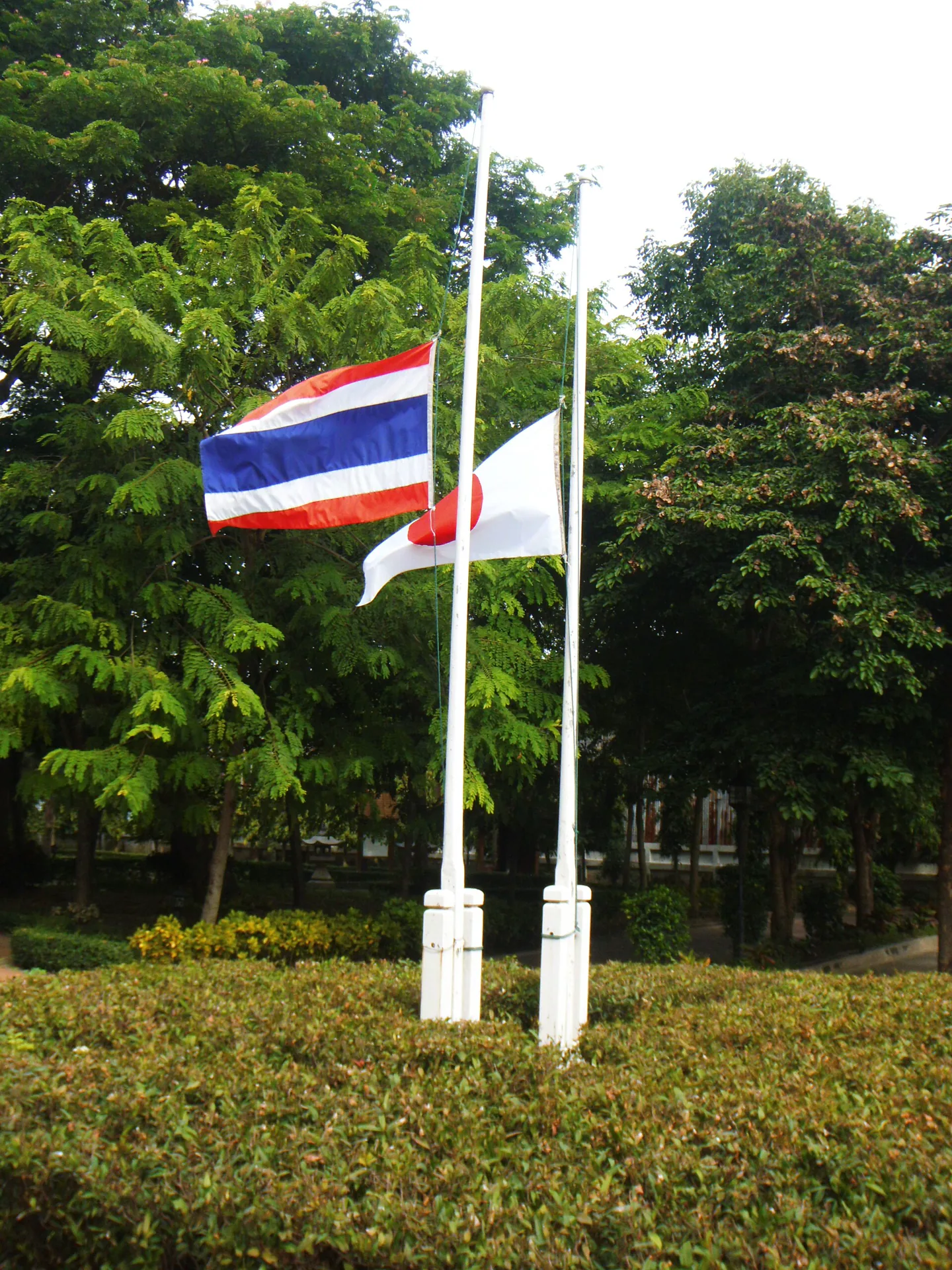
- Ayutthaya Japanese Village grounds - กสิณธร ราชโอรส, CC BY-SA 4.0; resized and converted to WebP, display crop.