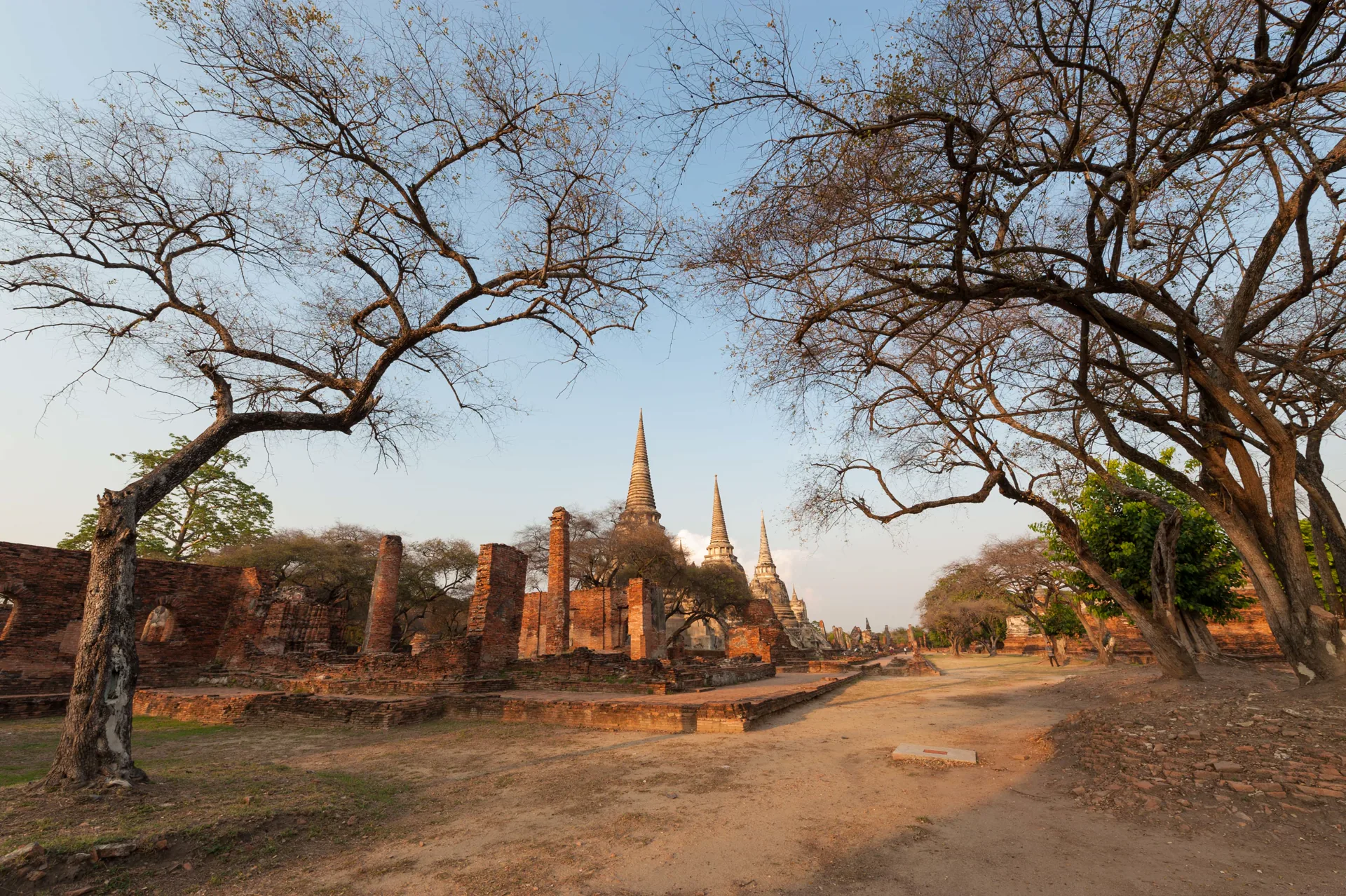
Palace quarter ceremony beyond the chedis
The three chedis are the visual anchor, but the deeper subject is royal space: a palace complex, a court temple and ceremonial movement whose missing buildings must be read through foundations, axes and surviving objects.
Four scales restore the quarter
Move from city to court to building to object. The order keeps famous chedis from floating without purpose.
Island capital
Locate the royal quarter within the waterways and administrative center of the former capital.
Palace relationship
Read the temple as part of royal ceremonial life rather than an isolated monastery.
What survived elsewhere
Use official interpretation and museum collections to connect foundations with material culture.
Let the axis do the explaining
Walk the perimeter and identify the principal line before photographing individual chedis. Repeated forms, spacing and surviving platforms reveal hierarchy that disappears when every structure is treated as a separate attraction.
Find the boundaries
Ask where palace, court temple and adjacent compounds begin and end. Modern paths do not always reproduce historical circulation.
Read repetition
The three principal chedis become more meaningful as a sequence linked to royal commemoration, not merely a skyline.
Use absence carefully
Missing wooden or damaged structures leave open ground. Treat interpretation as evidence, not permission to invent a complete palace.
Return to masonry
Only after the plan is clear, examine brick, stucco traces, stairs and repairs from permitted paths.
Use Chao Sam Phraya as the object room
The national museum is not an optional shelter appended to the itinerary. Its collections give scale, material and provenance to a city whose exposed brick cannot show court objects, craftsmanship or the full afterlife of excavated material.
Choose the order by attention
- Museum first: learn forms and materials before entering the ground plan.
- Museum second: carry site questions into a curated environment.
- Hot afternoon: move indoors when outdoor attention collapses.
- Closed day: verify the official schedule and keep a different indoor plan.
Do not quote a fixed hour from this page; use the Fine Arts Department's current listing.
Preserve energy for the main axis
Approach from the edge
Use the cooler window to understand boundary and orientation before the central chedis draw every camera.
Complete the temple loop
Move slowly around permitted areas, comparing alignment and surviving building types.
Break completely
Use shade and a proper meal. Do not add another exposed ruin merely because it is nearby.
Move to objects
Visit the museum when current hours align, or reserve it for the next morning rather than rushing both.
Palace-quarter FAQ
Why are the three chedis important?
They are central visual and commemorative elements within a royal temple complex. Their importance becomes clearer when read with the palace relationship and wider ceremonial plan.
Can I see a complete royal palace?
No. The visit relies on foundations, surviving monuments and interpretation. Come prepared to read space rather than furnished interiors.
How much time should I allow?
A substantial half day works for the quarter and museum context, adjusted for current opening and heat. Adding Mahathat and Ratchaburana can fill a complete central-island day.
Is the museum essential?
It is the strongest complement to the exposed ground plan because objects and provenance restore material evidence absent from the ruins.
Archaeological pair, west-island shade or atlas?
Official sources and photo credit
Reviewed 26 August 2026. Opening, admission, museum exhibitions and conservation access can change. Image was resized and converted to WebP; visible framing may crop the display.
- Fine Arts Department - Ayutthaya Historical Park.
- Fine Arts Department - Chao Sam Phraya National Museum.
- UNESCO World Heritage Centre - Historic City of Ayutthaya.
- Wat Phra Si Sanphet - Preecha.MJ, CC BY-SA 4.0; resized and converted to WebP, display crop.